 Stark
Stark Experience, Expertise, Authoritativeness, Trust (EEAT): The Four Pillars of Modern Ranking
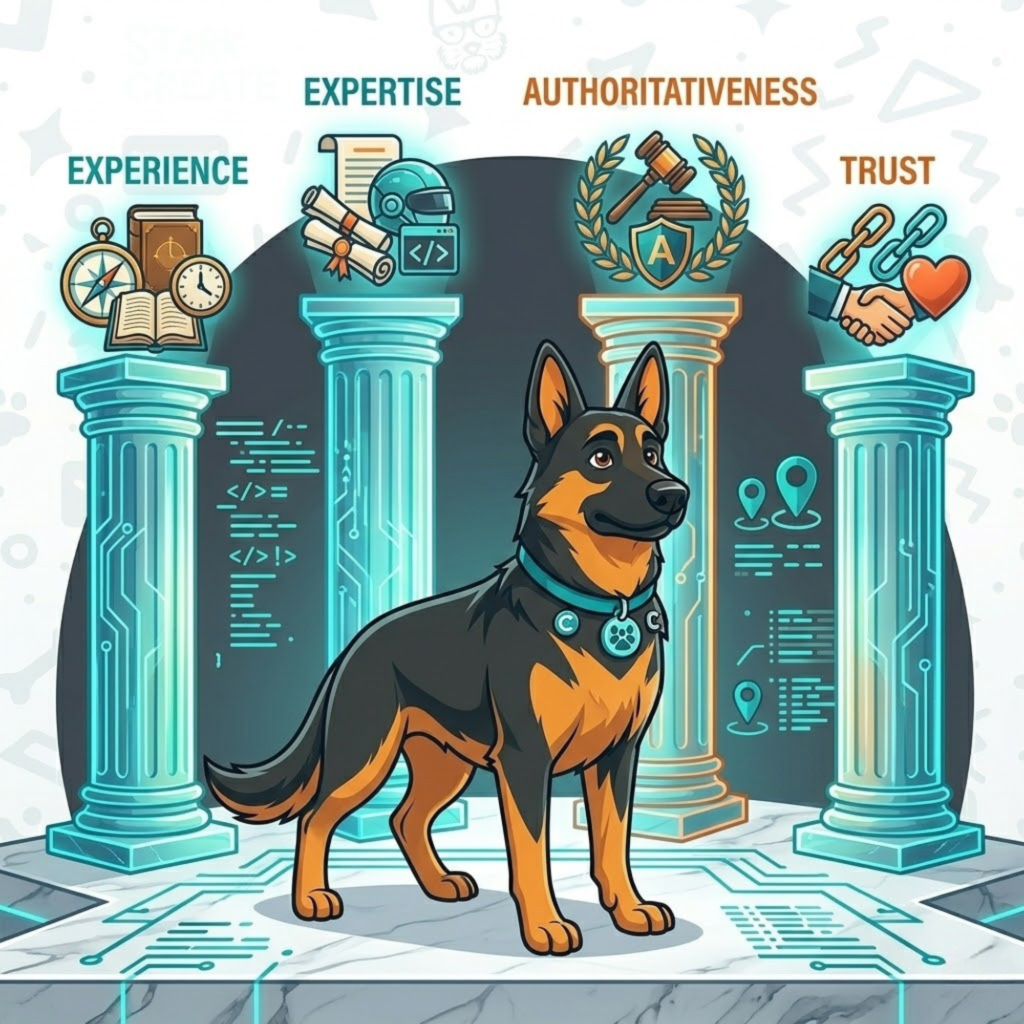
In a digital landscape overflowing with generic, artificially generated content, search engines have drastically changed how they evaluate and rank websites.
To survive and thrive in 2026, businesses must stop relying on outdated keyword tricks and start building their digital house on the solid foundation of E-E-A-T.
For years, many business owners were led to believe that SEO was just a game of mathematics and manipulation. If you stuffed enough keywords into a page, bought enough cheap backlinks, and published a certain number of words, you could trick Google into handing you the top spot. But those days are completely over. The modern search algorithms have grown up. They are no longer easily fooled by empty fluff. Instead, they are actively hunting for genuine human value. This shift is driven by a framework known as E-E-A-T, which stands for Experience, Expertise, Authoritativeness, and Trustworthiness.
At Stark Create, we have seen far too many businesses fall victim to “bad actors” in the marketing industry who sell automated, low-effort content that completely ignores this framework. These shady agencies will pump your website full of robotic jargon that might look impressive at first glance, but actually destroys your credibility with both search engines and potential customers. As your Guardian of Integrity, we want to peel back the curtain on how search engines really evaluate quality in 2026. Understanding the four pillars of E-E-A-T is no longer optional; it is the absolute prerequisite for fetching real, sustainable business online.
The AI Factor: Why E-E-A-T is More Critical Than Ever
The explosion of generative AI has fundamentally altered the internet. Because it is now possible to generate thousands of words in seconds, the web is flooded with “synthetic” content. Search engines like Google recognized that if they didn’t filter out this noise, their search results would become completely useless to human beings.
To combat this, Google leaned heavily into its Quality Rater Guidelines, placing E-E-A-T at the very center of its ranking philosophy. The algorithm is essentially asking a series of human-centric questions before it decides to show your website to a user: Has this person actually done what they are writing about? Do they have the credentials to give this advice? Are they recognized by other experts in the field? Is this business safe and legitimate? If your website fails to answer “yes” to these questions, it will be buried underneath competitors who can prove their worth.
Pillar One: Experience (The “Real-World Scars”)
The first “E” in the framework stands for Experience, and it is the ultimate differentiator between a human expert and an AI chatbot. Experience is defined by firsthand, real-world involvement with a topic. It answers the question: “Has the author actually lived through this?”
An AI can write a comprehensive, grammatically perfect article about the theory of fixing a transmission, but it has never held a wrench, scraped its knuckles, or dealt with a frustrated customer in a hot garage. If you want to rank in 2026, you must showcase your real-world scars. This means publishing original case studies, sharing specific anecdotes from client interactions, using your own proprietary data, and uploading original photos of your team actually doing the work. You need to prove that your knowledge isn’t just theoretical; it has been battle-tested in the real world.
Pillar Two: Expertise (The Depth of Knowledge)
While Experience is about what you have
done
, Expertise is about what you
know
. It refers to the depth of your knowledge and the specific skills you have acquired in your field. Are you a licensed professional, a certified technician, or a seasoned veteran with decades of industry insight?
Search engines look for Expertise by analyzing the comprehensiveness of your content and the credentials of your authors. If your website publishes shallow, 500-word blog posts that only scratch the surface of a topic, you are signaling a lack of expertise. To satisfy this pillar, your content must go deep. You must answer the complex, nuanced questions that only a true professional would know to ask. Furthermore, every article on your site should be attributed to a real person with a detailed author bio that lists their qualifications, education, and professional background. Hiding behind a generic “Admin” or “Editorial Team” byline is a massive red flag in modern SEO.
Pillar Three: Authoritativeness (The Industry Reputation)
You can claim to be an expert with years of experience, but Authoritativeness asks a more difficult question: “Does anyone else agree with you?” This pillar measures your reputation within your specific industry and across the broader digital landscape.
Authoritativeness is largely built off-site. It is demonstrated when other reputable websites link back to your content, when industry publications mention your brand, and when your team is invited to speak at conferences or guest-host podcasts. It is the digital equivalent of word-of-mouth marketing. You cannot buy true authority; it must be earned by consistently producing high-quality work that others naturally want to cite. If the top players in your industry view your website as a reliable source of truth, search engines will do the same, rewarding you with higher visibility and stronger rankings.
Pillar Four: Trustworthiness (The Core of the Framework)
Of all the elements in the E-E-A-T framework, Trustworthiness is by far the most important. In fact, Google explicitly states that if your website is not trustworthy, no amount of Experience, Expertise, or Authority will save your rankings. Trust is the foundation that the other three pillars stand upon.
Trustworthiness evaluates the legitimacy, transparency, and safety of your digital house. Search engines look for very specific technical and structural signals to measure this. Is your website secured with an SSL certificate (HTTPS)? Do you have clear, easily accessible contact information and a physical address? Are your refund policies, privacy policies, and terms of service transparent and easy to read? Additionally, are your customer reviews genuine, and do you respond to them professionally? If a user feels scammed, misled, or unsafe on your website, Google will ensure that they never see your business in the search results again.
The YMYL Exception: When E-E-A-T Becomes Mandatory
While E-E-A-T is important for every website, it is absolutely critical for a category of sites that Google labels “Your Money or Your Life” (YMYL). These are websites that offer advice or services that could significantly impact a person’s physical health, financial stability, legal standing, or safety.
If you are a doctor, a financial advisor, a lawyer, or a contractor dealing with home safety, the E-E-A-T standards you must meet are astronomically high. Google cannot risk serving a user inaccurate legal advice or dangerous medical tips. For YMYL businesses, proving your credentials, citing authoritative sources, and maintaining a flawless digital reputation is not just an SEO strategy; it is a strict requirement for basic visibility.
How to Pup-Grade Your Website’s E-E-A-T
Building E-E-A-T doesn’t happen overnight. It requires a deliberate, long-term strategy that touches every aspect of your digital presence. Here are a few ways to start cleaning up your digital house today:
- Audit Your “About Us” Page:
This is one of the most important pages on your site. It should clearly state who you are, how long you have been in business, and why you are qualified to do what you do.
- Showcase Verified Reviews:
Don’t just bury your testimonials. Put them front and center, and actively manage your Google Business Profile to show search engines that real people trust your services.
- Create Expert Author Profiles:
Link your blog posts to detailed author pages that highlight your team’s specific credentials and links to their professional LinkedIn profiles.
- Clean Up Your Technical SEO:
Ensure your site loads quickly, is fully secured, and uses proper schema markup (like LocalBusiness and Organization structured data) to explicitly tell search engines who you are.
Let the Guardian of Integrity Lead the Way
Navigating the complexities of E-E-A-T can feel overwhelming, especially when you are already busy running your day-to-day operations. The good news is that you don’t have to do it alone. At Stark Create, we specialize in extracting your hard-earned expertise and translating it into the exact digital signals that search engines demand.
We don’t rely on cheap tricks or robotic fluff. We build strategies rooted in authenticity, structuring your digital house so that your real-world authority shines through. If you are ready to stop barking up the wrong tree and want to build a digital presence that truly fetches results, it is time for a conversation. Visit our
page or call the Stark Create team directly at
to discuss how we can pup-grade your online authority today.
Disclaimer: The information provided in this article is for educational and informational purposes only and does not constitute professional marketing, financial, or legal advice. Contact Stark Create for custom strategies and solutions tailored specifically to your business needs.