Hyper-Local SEO: Why Your Marketing Radius is Shrinking (And How to Win It)

The days of a local business easily dominating search engine results across an entire city or county are officially over.
As search engines become hyper-focused on exact user proximity, your digital marketing radius is actively shrinking, and winning your immediate neighborhood is now more critical than winning the whole city.
If you own a brick-and-mortar store or a service area business in 2026, you have probably noticed a frustrating trend: your website traffic and lead generation from organic search might be dipping, even if you haven’t changed your strategy. Five years ago, if you were a plumber in Toledo, you could optimize your website for “Toledo Plumber” and expect to show up for users ten, fifteen, or even twenty miles away. Today, the digital landscape has shifted dramatically beneath our feet. Search engines like Google have updated their algorithms to heavily prioritize hyper-local proximity. They know that a user searching on their smartphone for a coffee shop, a roofer, or an accountant doesn’t want to drive across town; they want the absolute closest, highest-rated option available at that exact moment.
This shift has created a massive problem for businesses relying on outdated marketing advice. Unscrupulous agencies and “bad actors” in the SEO industry are still selling big, flashy, city-wide ranking packages, promising to make you the number one result for the entire metropolitan area. At Stark Create, we view this as a fundamentally dishonest practice. As your Guardian of Integrity, we are here to tell you that chasing massive, broad geographical keywords is often a waste of your marketing budget. The stark reality is that your effective digital marketing radius has shrunk to a matter of a few miles, or sometimes just a few blocks. But this isn’t necessarily bad news. By shifting your focus from broad-city SEO to a hyper-local strategy, you can stop chasing vanity metrics, dominate your immediate backyard, and fetch highly qualified leads that actually convert into real business.
The Proximity Update: Why Geography is the New Algorithm
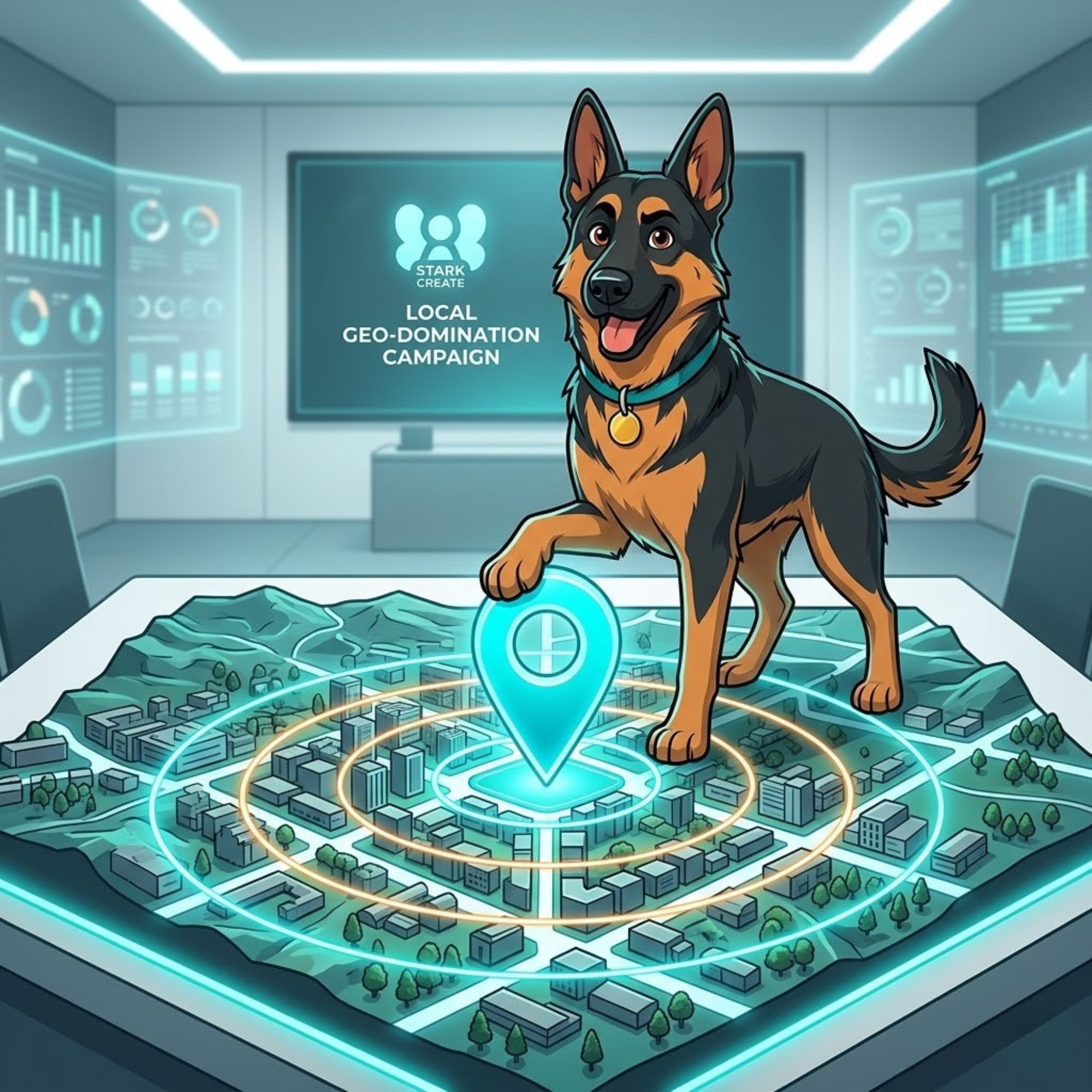
To win the local search game in 2026, you must understand the “Proximity to Searcher” ranking factor. When a user pulls out their phone and types in a service, Google essentially draws a tight, invisible circle around their current GPS location. The algorithm’s primary goal is to serve up businesses that are physically located inside that specific circle.
If your business is located on the north side of town, and a user is searching from the south side, the chances of your business appearing in the coveted “Local Map Pack” (the top three map results) are incredibly slim, regardless of how beautifully designed your website is or how many backlinks you have built. Google assumes the user wants convenience above all else. This hyper-local focus means your actual competition is no longer every similar business in the city; your competition is the two or three businesses operating in your specific zip code or neighborhood. Understanding this shrinking radius is the first step in realigning your digital strategy and taking back your local market share.
Why Chasing Broad City Keywords is Barking Up the Wrong Tree
For a long time, the holy grail of local SEO was ranking for a primary city keyword. Business owners poured thousands of dollars into ranking for terms like “HVAC Toledo OH.” While there is still some value in this, hyper-local SEO requires a much more granular approach.
When you only target the broad city, you are fighting against directories like Yelp, massive corporate franchises, and businesses with twenty-year-old domains. It is an uphill battle that often results in low return on investment. Instead of barking up the wrong tree, a hyper-local strategy focuses on neighborhood-specific keywords. Optimizing for “HVAC repair in [Specific Neighborhood]” or “Furnace replacement near [Local Landmark]” might yield a lower overall search volume, but the intent behind those searches is astronomically higher. When someone searches for a service in their exact neighborhood, they aren’t just browsing; they are ready to pull out their credit card and buy. Hyper-local SEO focuses on fetching these high-converting, bottom-of-the-funnel leads.
Your Google Business Profile: The Digital Front Door
In the era of hyper-local search, your website is often the second thing a user sees. The first is your Google Business Profile (GBP). In 2026, a massive percentage of local searches are “zero-click,” meaning the user finds your phone number, address, business hours, and reviews directly on the search results page without ever clicking through to your actual website.
If your digital house is messy—if your GBP is unverified, features outdated hours, lacks high-quality photos, or has the wrong service categories selected—you are essentially locking your digital front door and turning away neighborhood traffic. To win the hyper-local game, your GBP must be flawlessly optimized. You need to consistently upload fresh images of your storefront or service trucks, utilize the Q&A section to address neighborhood-specific concerns, and ensure your map pin is placed precisely where your front door is located. Search engines use your GBP as the absolute source of truth for your physical location; if it isn’t perfectly tuned, you will fall out of the local radius.
Local Content: Proving You Actually Know the Neighborhood
One of the most effective ways to signal your hyper-local relevance to search engines is through your website’s content. A generic “Service Area” page that just lists fifty different cities separated by commas is an outdated tactic that Google’s algorithm completely ignores today. To dominate your neighborhood, you have to prove you are an active part of it.
This means creating deep, meaningful, localized content. Write blog posts about projects you recently completed in specific neighborhoods. Mention local landmarks, cross streets, and community events. If you sponsor a local Little League team or participate in a neighborhood festival, write about it on your website! Furthermore, implementing specific LocalBusiness schema markup (structured data) in your website’s code explicitly tells AI search bots exactly which neighborhoods you serve. When your content proves that your brand is woven into the fabric of the community, search engines reward you by making you the hyper-local authority.
The Power of Hyper-Local Reviews
We all know that online reviews are critical, but in a hyper-local SEO strategy, what the reviewers say is just as important as the star rating they give you. Search algorithms actively crawl the text of your Google Reviews for localized keywords.
If you have fifty reviews that just say, “Great job, thanks,” that is nice, but it doesn’t move the SEO needle. However, if a customer writes, “Stark Create did an amazing job redesigning my website for my bakery right here in the historic West End district,” that review acts as a massive hyper-local ranking signal. Encourage your happy customers to mention the specific neighborhood they live in or the local landmark they are near when they leave a review. Additionally, always respond to your reviews, taking the opportunity to naturally reiterate your commitment to serving that specific area.
Let Stark Create Help You Dominate Your Block
The shrinking of the local search radius can feel intimidating, but it is actually a massive advantage for businesses that know how to play the game. By pivoting away from vanity city-wide metrics and focusing on hyper-local domination, you can build an impenetrable digital fortress right in your own backyard. You don’t have to outspend the giant national corporations; you just have to outsmart them at the neighborhood level.
At Stark Create, we don’t believe in selling you broad, ineffective promises. We believe in cleaning up your digital house, focusing on the strategies that matter in 2026, and fetching real, highly-qualified leads from the people living right down the street. If you are ready to stop wasting budget on a shrinking radius and want to give your local SEO a serious pup-grade, it is time to call in the experts. Visit our Contact us page or give our team a call at (419) 261-6551 to discuss your hyper-local strategy today.
Disclaimer: The information provided in this article is for educational and informational purposes only and does not constitute professional marketing, financial, or legal advice. Contact Stark Create for custom strategies and solutions tailored specifically to your business needs.
